Now open until 7pm +44 (0)20 3011 1280
Private Hearing Test London | Brain-Based Assessment from £199 | Verified Hearing

Harley Street and Wigmore Street, London

Private Hearing Test Londonthat tests more than your ear

You searched for a private hearing test in London. You are in the right place. But before you book anywhere, it is worth understanding what most hearing tests actually measure, and what none of them measure, until now.

Awajimijana Otana explaining the Brain-Based Hearing Assessment

Watch

What makes a Brain-Based Hearing Assessment different

2 minutes

No GP referral needed Same-day written report Results in 60 to 90 minutes RHAD registered audiologists

Brain-Based Hearing Assessment

£199 one-off, no referral
  • Consultation and clinical history
  • Otoscopy (ear canal examination)
  • Tympanometry (middle ear function)
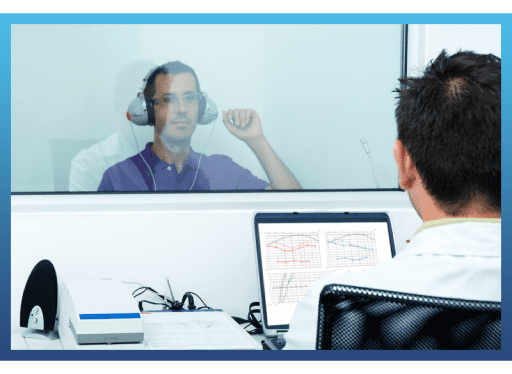
  • Pure-tone audiometry
  • Bone conduction testing
  • Speech discrimination testing
  • Speech-in-noise assessment
  • Brain-based interpretation and written report

Monday to Saturday, including evenings until 7pm

National Award, British Academy of Audiology
5-Star Google Rating, 200+ Reviews
Harley Street and Wigmore Street
Same-day written clinical report
No GP referral required

Before You Book Anywhere

You searched for a hearing test in London. Here is what you should know first.

Most people searching for a hearing test in London are asking one of two questions. Either they have noticed their hearing is getting worse and want to know how bad it is. Or they have been told by a partner, a colleague, or a GP that they should get it checked.

In both cases, they book a test expecting to come away knowing the real state of their hearing. The test is done, the audiogram is shown, a number is given, and most patients leave with either reassurance that their hearing is fine, or the recommendation to consider hearing aids.

The problem is not with that process. The problem is with what the test is actually measuring, and more importantly, what it is not. A standard audiogram measures what sounds you can detect at different frequencies. That is all it does. It says nothing about how your brain processes the sounds it receives. It says nothing about speech clarity in noise. It says nothing about the central auditory pathway.

For millions of people, that missing piece is the most important part of the picture. This page explains why, and what a complete hearing assessment in London actually looks like.

The numbers behind the gap

40%

Of people with hearing aids report still struggling to understand speech in noise, because the test that led to their fitting did not assess how the brain processes sound

6-18mo

Average NHS audiology waiting time in London, for a test that still uses a pure-tone audiogram as its primary tool

What Most Hearing Tests Miss

Why complimentary hearing tests and most private hearing tests in London give you an incomplete picture

The NHS hearing test

The NHS provides a genuinely valuable service, and we have great respect for what it offers. But their standard hearing test is a pure-tone audiogram. It measures the quietest sounds you can detect at different frequencies, takes around 30 minutes, and if loss is found, a hearing aid is the primary recommendation. It does not assess how the brain processes sound, how you perform in noise, or what the central auditory pathway is doing.

Average wait in London: 6 to 18 months

The high-street hearing test

A complimentary hearing test from a high-street hearing aid retailer is an audiometric screen. It is designed to take 20 to 30 minutes, identify whether you might benefit from hearing aids, and create an opportunity to discuss purchasing them. It is not a clinical diagnostic assessment. It tells you whether a loss is present. It does not tell you why, or what the brain is doing with the degraded signal it receives. It is a screen. Not an assessment.

What it is: A sales screening, not a clinical assessment

The standard private hearing test

A paid private hearing test at most London audiology clinics improves on the high-street screen by adding bone conduction, tympanometry, and sometimes speech discrimination. It is more thorough. But it is still missing the most important component: an assessment of how the brain processes and interprets sound. It still tests the ear. It does not test the auditory cortex or central pathway. The most clinically significant part of your hearing is left unexamined.

Typical cost: £50 to £150  ·  Still missing: Central processing

Every one of these tests is answering the same question: "What can you hear?"

The question none of them are answering is: "How is your brain processing what it hears?"

For many people, this is the more important question. They can hear sound but struggle to understand it clearly. They hear voices but cannot make out words in a noisy room. They have been told their hearing is fine, or that their hearing aids are working correctly, yet the problem persists. This is not a volume problem. This is a brain processing problem, and it is invisible on a standard audiogram.

The Science

What the Brain-Based Hearing Assessment tests that others do not

Understanding this changes how you think about hearing care, and what kind of assessment is worth your time.

01

Sound begins at the ear. It is completed by the brain.

When sound enters the ear, the cochlea converts it into neural signals. Those signals travel through the auditory nerve to the auditory cortex, where the brain organises, filters, separates speech from noise, and interprets meaning. Hearing is not detection. It is interpretation, and interpretation happens in the brain.

02

Hearing loss changes the signal before it reaches the brain.

A damaged cochlea does not simply reduce volume. It distorts the signal. The neural information reaching the brain is degraded and incomplete. Over time, the brain adapts to this degraded input, reshaping how it processes and interprets sound to compensate for what it is no longer receiving clearly.

03

A hearing aid amplifies the signal. It does not retrain the brain.

When a hearing aid delivers a louder version of the same signal, the brain does not receive a restored signal. It receives a louder version of the degraded one, and continues to decode it using the maladapted patterns it developed in the absence of clear sound. Without retraining, the problem persists despite adequate amplification.

04

This is why many people struggle despite audiograms showing otherwise.

You may be told your hearing is mild or even normal, and still struggle profoundly in noise. This is because the audiogram measured only the peripheral system. It did not measure central auditory processing. The Brain-Based Hearing Assessment measures both. It is the only way to know the full picture.

The Brain-Based Hearing Assessment maps both systems.

It is the only private hearing test in London that combines peripheral hearing assessment with central auditory processing assessment. The result is not an audiogram with a recommendation. It is a complete clinical picture of your hearing, with a written report explaining exactly what it means and what the pathway forward looks like.

What Is Included

Your £199 Brain-Based Hearing Assessment, step by step

Eight components. 60 to 90 minutes. A written clinical report the same day. No other private hearing test near you includes all of this as standard.

01

Consultation and clinical history

Your audiologist discusses your hearing concerns, lifestyle, listening environments, and any history of noise exposure, tinnitus, or family hearing loss. This informs how results are interpreted in context, not just in isolation.

02

Otoscopy

Visual examination of the ear canal and eardrum using a clinical otoscope. Checks for ear wax blockage, inflammation, perforation, or other physical factors that may be affecting hearing and that a hearing screen would miss entirely.

03

Tympanometry

Measures the movement of the eardrum in response to changes in air pressure. Identifies middle ear problems such as fluid behind the eardrum, Eustachian tube dysfunction, or otosclerosis. These conditions can cause significant hearing difficulty but are invisible on a pure-tone audiogram alone.

04

Pure-tone audiometry

The standard audiogram. Tests your ability to detect tones at frequencies from 250 Hz to 8000 Hz in each ear. Identifies the type and degree of any hearing loss. Every hearing test in London includes this. Our assessment goes considerably further.

05

Bone conduction testing

Tests how sound is conducted through the bones of the skull directly to the cochlea, bypassing the outer and middle ear. This determines whether hearing loss is conductive or sensorineural, which directly determines the correct clinical pathway. Many high-street tests skip this entirely.

06

Speech discrimination testing

Measures your ability to accurately repeat words presented at a comfortable listening level. Identifies whether clarity difficulties are above and beyond what the audiogram would predict, which indicates central processing involvement and changes the clinical pathway significantly.

07

Speech-in-noise assessment

The component that most differentiates our assessment from every other private hearing test in London. Tests your ability to understand speech against competing background noise, replicating the most difficult real-world listening environments. This directly measures auditory processing function and the brain's ability to separate signal from noise. A standard audiogram cannot reveal any of this.

08

Brain-based interpretation and written clinical report

All results are interpreted through the lens of central auditory processing, not only peripheral thresholds. You leave with a full written clinical report on the same day, explaining what each result means, what the complete clinical picture shows, and what the pathway forward looks like. Not a printout of a graph. A comprehensive clinical document you can take away, share with a GP, or refer back to at any time.

Brain-Based Hearing Assessment

£199

  • 8 assessment components
  • 60 to 90 minutes
  • Written report same day
  • No GP referral needed
  • Both London clinics
Book Now Call to ask a question

How It Compares

Brain-Based Hearing Assessment vs all other options in London

Eight components. Every available option. The picture becomes clear.

What is tested NHS High Street Standard Private Brain-Based
Verified Hearing
Pure-tone audiometry
Bone conductionSometimes
TympanometrySometimesSometimes
Speech discriminationSometimes
Speech-in-noise testing
Central processing assessment
Brain-based interpretation
Same-day written reportSometimes
No GP referral needed
Waiting time6 to 18 monthsSame dayWithin daysWithin days
CostFreeFree£50 to £150£199

The question is not whether £199 is expensive. The question is whether an assessment missing five of these eight components is telling you what you actually need to know about your hearing.

Who Should Book

You should book this assessment if you recognise any of the following

You struggle in noise despite being told your hearing is fine

You have had a hearing test before and been told your hearing is normal or only mildly reduced. But you still find restaurants, group conversations, or meetings genuinely difficult. Your audiogram appears normal because the peripheral system appears normal. The problem is at the processing level, and it is invisible to a standard test.

You have hearing aids but still struggle

Many people with hearing aids continue to struggle because the original assessment that led to their fitting was a standard audiogram. It measured the ear and missed how the brain processes the signal. The Brain-Based Hearing Assessment identifies what was never measured the first time, and what the Brain-Based Hearing Programme™ can address.

You have tinnitus alongside your hearing difficulty

Tinnitus is frequently associated with changes in central auditory processing. A standard hearing test will not assess the neurological factors involved. Our Brain-Based Hearing Assessment addresses both. If you need specialist tinnitus treatment after assessment, our audiologist will guide you toward the NeuroQuiet Tinnitus Training Programme™.

You want a thorough hearing baseline before it becomes a problem

Perhaps your hearing is fine now and you want to know exactly where you are before age, noise exposure, or other factors change that. Our assessment establishes your complete baseline across all eight components. If anything changes in the future, you have a precise clinical starting point to measure it against.

Your Audiologist

The audiologist who will assess you at Harley Street and Wigmore Street

AJ

Awajimijana Otana

Founder and Clinical Audiologist

Known as AJ, our founder was nationally recognised by the British Academy of Audiology during his training years, holding an MSc in Audiology from the University of Manchester. He brings experience from NHS specialist posts and private practice across two continents, and is known for his warmth and clinical precision, particularly with patients who have had unsatisfying or incomplete assessments elsewhere.

Brain-Based Audiology Diagnostic Audiology Speech-in-Noise RHAD

Google Reviews

What patients say about their hearing assessment

★★★★★

"I came because I wanted a Harley Street specialist to look after my ear rather than a GP. Awajimijana is extremely warm and friendly, and was able to explain everything very clearly. The most thorough hearing assessment I have ever had. I cannot recommend him highly enough."

H

Hani

Google Review, Harley Street

★★★★★

"After experiencing a sudden loss of hearing I was seen at very short notice. Extremely comfortable from start to finish. The improvement was instant. A very thorough explanation of the process with a clear concern for the best outcome. Highly recommended."

T

Thomas D.

Google Review, Harley Street

★★★★★

"Can't rate highly enough. Excellent service. A very thorough explanation of the processes with a clear concern for the best outcome. AJ was attentive throughout, knew exactly what he was doing, and made the whole experience completely comfortable."

C

Catherine W.

Google Review, Wigmore Street

Questions

Frequently asked questions about our private hearing test in London

A complimentary hearing test from a high-street retailer is a pure-tone audiogram. It measures the quietest sounds you can detect at different frequencies, takes roughly 20 to 30 minutes, and is designed to identify whether you might benefit from hearing aids. Our Brain-Based Hearing Assessment takes 60 to 90 minutes and tests eight components, including how your auditory cortex processes and interprets sound. The standard test tells you what you cannot hear. Ours tells you why, and what the brain is doing with the signal it receives.

No. You can book directly online or by calling 020 3011 1280. No GP referral is required for any appointment at Verified Hearing, including the Brain-Based Hearing Assessment, tinnitus assessment, APD assessment, and ear wax removal.

The Brain-Based Hearing Assessment takes approximately 60 to 90 minutes. You receive your results and a full written clinical report on the same day. There is no waiting for letters or follow-up appointments just to find out what your results show.

Yes. If you have hearing aids but still struggle to understand speech in noise, experience listening fatigue, or find group conversations difficult, the Brain-Based Hearing Assessment will identify the central processing factors that your original assessment did not measure. Hearing aids restore access to sound. Only structured brain retraining, through the Brain-Based Hearing Programme™, restores how the brain decodes it.

Yes. Tinnitus is frequently associated with changes in central auditory processing. Our Brain-Based Hearing Assessment includes components relevant to tinnitus. If you need specialist tinnitus treatment, we offer the NeuroQuiet Tinnitus Training Programme™, which can be discussed at your appointment or booked separately.

A complimentary or low-cost hearing test measures pure-tone thresholds only. Our £199 assessment includes eight components that no other standard private hearing test in London provides as a complete package. The question is not whether £199 is expensive. The question is whether an incomplete assessment, missing five of those eight components, is telling you what you actually need to know about your hearing. An incomplete assessment is not a bargain at any price.

We have two central London clinics. 1 Harley Street, London W1G 9QD, nearest tube Oxford Circus (5 minute walk). And 126 Wigmore Street, London W1U 3RY, directly opposite Selfridges, nearest tube Bond Street (3 minute walk). Both clinics are open Monday to Saturday including evenings until 7pm.

Book Your Assessment

Choose a time at Harley Street or Wigmore Street

Monday to Saturday including evenings until 7pm. No GP referral. Both central London clinics available.

Our Clinics

Two central London locations for your private hearing test

Harley Street

1 Harley Street, London W1G 9QD

Nearest tube Oxford Circus, 5 min walk. Regent's Park, 7 min walk.

Hours Monday to Saturday, 9am to 7pm

Phone 020 3011 1280

Get directions

Wigmore Street

126 Wigmore Street, London W1U 3RY

Location Directly opposite Selfridges

Nearest tube Bond Street, 3 min walk

Hours Monday to Saturday, 9am to 7pm

Get directions

You came looking for a hearing test in London

Now you know what a complete one looks like

The Brain-Based Hearing Assessment is the only private hearing test in London that tests both the ear and how the brain processes what it hears. Eight components. Same-day written report. No GP referral. Available at Harley Street and Wigmore Street.

Monday to Saturday including evenings until 7pm. Harley Street and Wigmore Street, London.

Brain-Based Hearing Assessment

£199 · Same-day report · No GP referral

Book Now
Call us 020 3011 1280